Students from the Oregon Consulting Group (OCG) are helping shape the future of transportation in Lane County (and possibly the world), collaborating with the electric vehicle manufacturer Arcimoto to launch a vehicle rental program based in Eugene. With student input, a city-wide rental program for Arcimoto’s electric vehicles is tentatively set to launch in time for the Oregon ’22 World Athletics Championship to be held at Hayward Field.
The University of Oregon has received a $4.52 million grant from The Andrew W. Mellon Foundation to support a new initiative envisioning a transformative research platform for racial and climate justice. It is the largest humanities award in UO history.
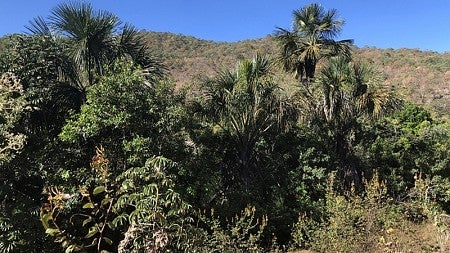
The forest-savanna borderlands, known as the Amazon-Cerrado transition, experience broad climatic and ecological influences. The study addressed uncertainties related to those influences in the tropical ecosystem, said Silva, a professor in the Environmental Studies Program, Department of Geography and Institute of Ecology and Evolution.
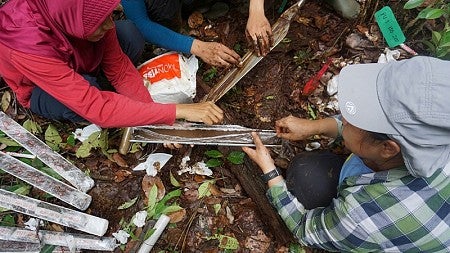
A University of Oregon-led research team has identified tropical peatland in Indonesia that is twice as old and much deeper than previously thought. The findings, published in Environmental Research Letters, provide new insights about the climate of equatorial rainforests, especially during the last ice age, said study co-author Dan Gavin, a professor of in the Department of Geography.
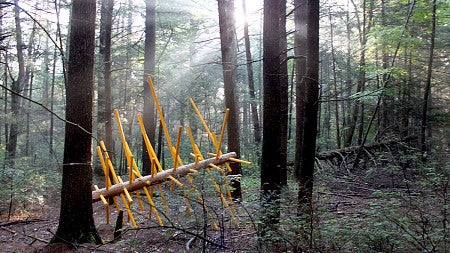
Starting fall term, Cambridge-based multidisciplinary artist and designer David Buckley Borden will be a visiting professor at the Department of Landscape Architecture. Borden will bring landscape design and art experience to the School of Architecture & Environment, such as his work at the Harvard Forest in Massachusetts, where he is currently a Harvard Forest Associate Fellow.
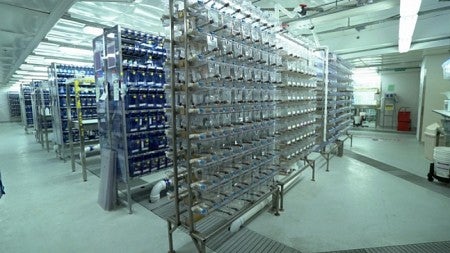
A UO-led team of researchers spanning physics, neuroscience, molecular biology, ecology and evolution will use a new $325,000 grant to examine aquatic symbioses — the interactions between different animal species living together. The project is funded by a 30-month award from the Gordon and Betty Moore Foundation and involves the study of zebrafish in controlled ecosystems.
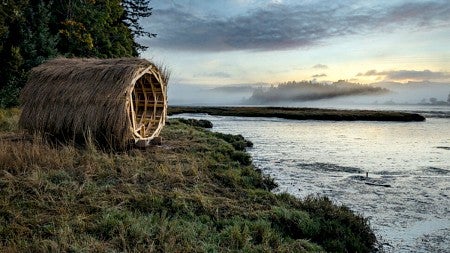
Erin Moore, director of the School of Architecture & Environment, is using architecture as a form of protest against the construction of the Pacific Connector Pipeline, she recently told Metropolis, a magazine about sustainable architecture and design. The story explores Moore’s “Pipeline Portals,” three pavilions installed along proposed routes of the contested Pacific Connector Pipeline, a 229-mile gas line planned for construction across the Pacific Northwest.
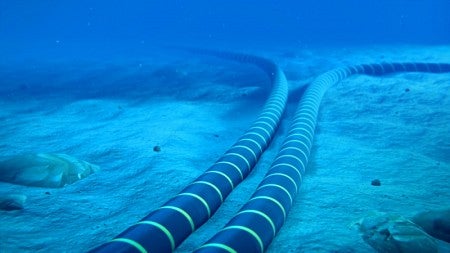
A University of Oregon doctoral student is exploring how technological infrastructure located on the ocean floor, particularly submarine internet cables, has influenced people’s lives in the Pacific Northwest. Hayley Brazier is driven by two big questions: How and why have people come to depend so heavily on infrastructure scattered across the ocean floor? And how would a natural disaster affect coastal society?
Stringent social distancing measures and building cleaning efforts to protect occupants from the coronavirus that causes COVID-19 are in line with research conducted in the University of Oregon’s Biology and the Built Environment Center.
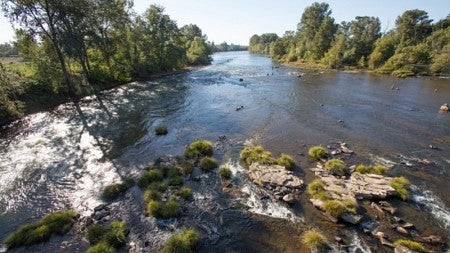
The Year of Water is a joint effort by the University of Oregon, Oregon State University and Portland State University to highlight the role Oregon’s research universities play as leaders and partners trying to address water-related challenges in Oregon, the region and the world.
The UO School of Journalism and Communication’s center for advancing science communication research has launched a new name and two new interdisciplinary research programs.
With the consumption of plant-based alternatives rising among these generations challenging the dairy industry, Paul Snyder sought a cohort of students that could think creatively and critically about how to capture these changes in Tillamook’s branding.
With a background in geology, mining, and the oil and gas industry, Christina Calvin’s success underlines the fact an MBA with a focus in sustainable business is increasingly relevant to students and professionals from diverse backgrounds and areas of interest—especially the sciences.
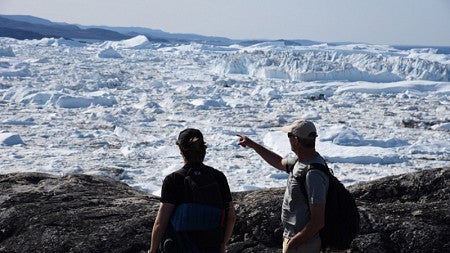
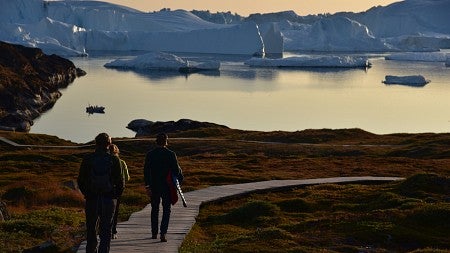
Three professors will co-teach "Arctic Icebergs" in Spring 2020, a course that comprehensively examines climate change with aspects of environmental research, literature, and natural science.
There was a belief that health could be improved through building design, but as the world experienced an oil crisis and saw the effects of climate change, design focus shifted to energy conservation.